A video I made last year for my bio class explaining cellular respiration:
Showing posts with label water. Show all posts
Showing posts with label water. Show all posts
Friday, December 30, 2011

Photosynthesis
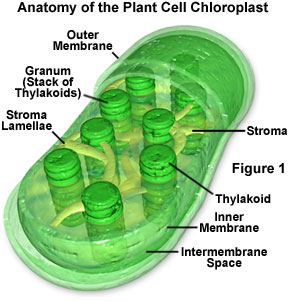 It's a well known fact that plants need water and sunlight to make food, but how is that possible? Essentially, plants create their own food through a process called photosynthesis. Photosynthesis is made up of two different processes called the light dependent reaction (also called the light reaction) and the light independent reaction (also called the dark reaction or the Calvin cycle). Both of these reactions take place in the chloroplast (shown at the left). The light reactions specifically take place in the thylakoid. Inside each thylakoid there is a system very similar to the electron transport system. This reaction is shown in the image below labeled "Light dependent reaction". This reaction begins with energy from the sun. The plant can use this energy because they have several pigments, one of which is chlorophyll. These pigments allow the plant to absorb the sun's energy. One photon of energy enters into photosystem two (PSII) and bounces off of the walls of photosystem two. The photon then reaches the reaction center at the base of the photosystem. There, a water molecule (H2O) has broken apart into H+ and O2. When the water is broken apart, an electron is released. The photon excites the electron, giving is energy. This electron travels up to the top of photosystem two. It then descends across the system and entersphotosystem one (PSI). As is descends it pumps one H+ ion from the stroma into the thylakoid lumen (the area inside the thylakoid). Once the electron is inside photosystem one, it travels upward until is reaches the electron carrier. There, it reduces NADP+ to NADPH. As this process repeats, a high concentration of H+ ions is build up in the lumen. These ions then travel through the ATP synthase one by one. As they move through, they physically rotate the synthase. This creates energy, and the energy converts ADP and P to ATP.
 As a review, the inputs of the light dependent reaction are as follows:
1 H2O
Light
and the outputs are:
1 H2O
Light
and the outputs are:
1 O2 (final product)
2 ATP (used in the Calvin Cycle)
1 NADPH (used in the Calvin Cycle)
 |
| Light dependent reaction |
The next component of photosynthesis is the Calvin Cycle. The calvin cycle creates G3P, or PGAL, which the plant uses to make glucose. It takes three molecules of CO2 to create one molecule of PGAL, therefore this explanation will be describing the cycle in terms of three molecules of CO2. The Calvin Cycle begins with CO2, in this instance three molecules. These molecules of CO2 combine with three molecules of RuBP to form a six carbon molecule. The enzyme rubisco assists in this joining. This is a brief transition phase, and soon these molecules split into three carbon molecules, for a total of six three carbon molecules. These molecules must be rearranged and gain phosphates. Therefore, six ATP oxidize to form ADP and six NADPH oxidize to form six NADP+ and phosphate. Next, the three carbon molecules each lose a carbon. These carbons form a PGAL, and the unused substances are rearranged. The rearranging takes energy, and three ATP oxidize to become 3 ADP. The result is three Rubisco and the cycle continues. When two PGALs are created, they combine to form glucose.
As an overview, the inputs of the Calvin cycle (when one pyruvate is created) are:
3 CO2
9 ATP
6 NADPH
And the outputs are:
9 ADP
6 NADP+
6 P
1 Pyruvate

The equation for photosynthesis is: 6CO2 + 6H2O -> C6H12O6 + 6CO2
This autotrophic system of plants is amazing. Plants take in CO2 and water, two substances that are abundant on our planet, and they convert them to food and oxygen. This phenomenon is present every plant, and even some species of bacteria. It is an essential factor to maintaining the delicate balance of life on Earth. Although we have not yet studied this in class, I believe that the amount of light will assist in photosynthesis and the amount of water. Light would increase the amount of photosynthesis because light is used to excite the electron in the light reaction and water would assist because if there is a lack of water a light reaction cannot occur and therefore there will be no energy to use in the dark reaction.
Sources:
http://en.wikipedia.org/wiki/Photosynthesis
As an overview, the inputs of the Calvin cycle (when one pyruvate is created) are:
3 CO2
9 ATP
6 NADPH
And the outputs are:
9 ADP
6 NADP+
6 P
1 Pyruvate
The equation for photosynthesis is: 6CO2 + 6H2O -> C6H12O6 + 6CO2
This autotrophic system of plants is amazing. Plants take in CO2 and water, two substances that are abundant on our planet, and they convert them to food and oxygen. This phenomenon is present every plant, and even some species of bacteria. It is an essential factor to maintaining the delicate balance of life on Earth. Although we have not yet studied this in class, I believe that the amount of light will assist in photosynthesis and the amount of water. Light would increase the amount of photosynthesis because light is used to excite the electron in the light reaction and water would assist because if there is a lack of water a light reaction cannot occur and therefore there will be no energy to use in the dark reaction.
Sources:
http://en.wikipedia.org/wiki/Photosynthesis
Images:
http://dft.ba/-anQ
http://micro.magnet.fsu.edu/primer/java/photosynthesis/
http://www.daviddarling.info/images/Calvin_cycle.jpg
http://www.daviddarling.info/images/Calvin_cycle.jpg
Sharks!!!
Before dinosaurs roamed the earth, sharks were swimming the seas. For 420 million years, sharks have been evolving and adapting to their environments. One of the most essential aspects of this evolution has been the development of osmoregulation. There are three primary environments in which osmoregulators live: terrestrial, freshwater, and marine. Because sharks primarily live in saltwater, they live in the marine environment. This environment can pose a problem to many animals, as it makes it hard for them to achieve homeostasis, the state at which the ratio of solutes to solvent inside the body equals the ratio of solutes to solvents outside of the body. It is one of the most basic goals of any animal to acheive homeostasis, and thus, over time, each species of animal has developed a unique way of balancing the ratios. A shark is an osmoconformer, as are most animals that live in the marine environment. This means that it adapts its internal environment to have homeostasis with that of the outside. The bodies of sharks are especially high in two substances, urea and trimethylamine N-oxide. Urea is commonly found in urine, and trimethylamine N-oxide is commonly found in decomposing animals. Both of these compounds allow a shark to be isotonic. Any excess salt in the body is removed through the urine. Thus, unlike most animals that live in salt water, sharks do not drink the water that they live in. Instead, they change their concentration gradient by storing large amounts of chemicals inside of their own bodies. This allows can absorb water straight from the ocean and into their own cells. However, this prevents most sharks from living in fresh water, with few exceptions. One of these exceptions would be the bull shark. A bull shark has adapted its kidneys so that when the shark moves into freshwater, the kidneys expel less salt and more urea, allowing the shark to retain more of the salt necessary to reach homeostasis. Overall, the ability of a shark to osmoconform has been vital to their survival for millions of years.
Fun facts:
These facts do not relate to osmoregulation, but they relate to sharks and are quite interesting!
1. The skeleton of a shark is made entirely of cartilage
2. Great White sharks can jump ten feet into the air!
3. Certain species of sharks will stop breathing if they stop moving
4. Great White sharks eat 11 tons of food in one year!
5. A mere 20 of the 350 species of sharks worldwide have attacked humans
6. On average, people kill 73,000,000 sharks each year
7. Magnets can repel sharks
8. Sharks are able to hear the fish that they eat from 800 feet away
9. Sharks can smell one drop of blood in an area of water equivalent to that of an olympic pool (660,000 gallons)
10. The smallest type of shark is eight inches long!

An image of the pygmy shark, the world's smallest shark
Sources:
http://www.thebiohub.blogspot.com
http://en.wikipedia.org/wiki/Shark
http://www.sharks.org.za/osmoregulation.html
http://dsc.discovery.com/sharks/top-shark-facts-10.html
http://dsc.discovery.com/sharks/top-shark-facts-03.html
http://dsc.discovery.com/sharks/top-shark-facts-01.html
http://dsc.discovery.com/sharks/top-shark-facts-04.html
http://dsc.discovery.com/sharks/top-shark-facts-08.html
http://dsc.discovery.com/sharks/top-shark-facts-07.html
http://en.wikipedia.org/wiki/Olympic-size_swimming_pool
http://dsc.discovery.com/sharks/top-shark-facts-09.html
http://static.howstuffworks.com/gif/great-white-shark-1.jpg
http://static.howstuffworks.com/gif/pygmy-shark-2.jpg
http://en.wikipedia.org/wiki/Bull_shark
http://www.sharksavers.org/en/education/shark-biology-behavior/385-how-bull-sharks-can-live-in-fresh-water-through-clever-osmoregulation.html
http://www.thebiohub.blogspot.com
http://en.wikipedia.org/wiki/Shark
http://www.sharks.org.za/osmoregulation.html
http://dsc.discovery.com/sharks/top-shark-facts-10.html
http://dsc.discovery.com/sharks/top-shark-facts-03.html
http://dsc.discovery.com/sharks/top-shark-facts-01.html
http://dsc.discovery.com/sharks/top-shark-facts-04.html
http://dsc.discovery.com/sharks/top-shark-facts-08.html
http://dsc.discovery.com/sharks/top-shark-facts-07.html
http://en.wikipedia.org/wiki/Olympic-size_swimming_pool
http://dsc.discovery.com/sharks/top-shark-facts-09.html
http://static.howstuffworks.com/gif/great-white-shark-1.jpg
http://static.howstuffworks.com/gif/pygmy-shark-2.jpg
http://en.wikipedia.org/wiki/Bull_shark
http://www.sharksavers.org/en/education/shark-biology-behavior/385-how-bull-sharks-can-live-in-fresh-water-through-clever-osmoregulation.html
The Properties of Water
Water is essential to the human lifestyle. Not only are we made up of water, but we drink it, wash with it, and can use it to create electricity. Water has many different properties, which contribute to the ways that we use it today.

Polarity
Polarity is a phenomenon that occurs in water because water is created by polar covalent bonds and hydrogen bonds. In a polar covalent bond, the atoms bonding do not share the electrons equally. Instead, the larger atom will pull the molecules farther towards itself. This gives the molecule a slightly positive side and a slightly negative side. The positive side of one water molecule is attracted to the negative side of other water molecules and objects and vice versa. This allows the molecules to stick together and stick to other things.
Cohesion
Cohesion, when referring to water, means that water molecules like to stick together. The cohesion happens because the molecules have polarity, and the negative side of one molecule is attracted to the positive side of another molecule, so on and so forth.
Adhesion
Adhesion is similar to cohesion. Adhesion means that the water molecules are attracted to other materials. This comes again from Polarity. If the material has a positive or negative charge, the water molecule will stick to it. An example of Adhesion is an experiment that we performed in Biology. In class, we took a balloon and charged it with static electricity by rubbing it against our heads. We then put this balloon near a stream of water. The water was drawn away from its path to the ground and towards the balloon.
Surface Tension
Surface tension is the tension created by the polar molecules in water pulling on each other. This tension gives water a slightly taut surface. If something is not heavy enough to break the surface tension then it will float on top of the water. We experimented with surface tension in the lab with water and a paper clip. When the paper clip was horizontally on the surface of the water its weight was evenly distributed. Thus, it was not heavy enough in one place to break the surface tension of the water and remained floating on the top of the water.
Capillary Action
Capillary Action is best shown in a straw. Because of their polarity, water molecules are attracted to the sides of the straw. This allows them to slide up the straw and to the top.
Specific Heat of Water
The specific heat of any substance is the heat needed to raise the temperature of one gram of the substance one degree Celsius. Water, unlike many other substances, has a very high specific heat. The specific heat of water is so high because the attraction between molecules is strong. Thus, it takes more energy to break the bonds apart and allow the water to heat up. Similarly, water takes a long time to cool down. An everyday instance of water's high specific heat is the beach. The water at the beach is warmest in the end of the summer because the sun has been heating it up all summer.
Universal Solvent
Water is called the universal solvent because many different things are able to dissolve in water. When mixed with other polar substances, the polar water molecules attract the polar molecules of the other substance and mix together. Water is able to dissolve myriad different liquids, gases, and solids. It will not, however, mix with non-polar substances, such as oil, because the molecules are not attracted to each other.
Value of Water Density
Water has a density of one gram per milliliter when it is a liquid. Substances that are less dense will float in water, and substances that are more dense will sink in the water. However, when water is a solid the molecules in the hydrogen bonds spread farther apart. This gives ice a lower density than liquid water, which allows it to float in the water.
PH
The pH of a liquid is how acidic or basic the substance is. Water is naturally neutral, with a pH of 7 on a scale of 0 to 14. Water, however, can be ionized. Ionization is the conversion of a non-ionic compound into ions. Water is constantly becoming ionized and un-ionized. When water is broken down into ions it is made up of H-plus and OH-minus. When water has more H-plus ions it is acidic and when water has more OH-minus ions it is basic. Water being neutral is very important for living organisms. If rain becomes to acidic it is referred to as acid rain and can kill fish. Because human beings are mainly water, if we consume substances that are too acidic or basic we can die.
Subscribe to:
Posts (Atom)