Search This Blog

Showing posts with label cell. Show all posts

Monday, September 24, 2012

Everything You've Ever Wanted to Know About Carbohydrates!

Diagram of a glucose molecule.

You've probably heard quite a bit about carbohydrates.  When dieting you avoid them like the plague; they're in pastas, pizzas, and many other delicious Italian dishes.  But what, in fact, is a carbohydrate?  Carbohydrates are defined as molecules that are some form of sugar (either a polymer or monomer).  These sugars are composed of three elements:  Carbon, Hydrogen, and Oxygen in a 1:2:1 ratio. The carbohydrate most commonly found in nature is Glucose, with the molecular formula C6H12O6 (See right).  Carbohydrates perform several key functions for cells.  They store energy and they provide structure for living organisms.  The simplest sugars, such as Glucose, are referred to as monosaccharides.  Two monosaccharides can be combined to form a molecule called a disaccharide.  The process by which this occurs is called dehydration synthesis.  In dehydration synthesis, one monosaccharide donates a hydroxide ion (OH-) and another donates a hydrogen ion (H+).  These two ions form one molecule of H2O.
The result is that the two monosaccharides are held together in a glycosidic linkage.  Many monosaccharides can be combined in this way to form a polysaccharide.  Polysaccharides are the molecules that we usually think of as "carbohydrates".  They are composed of chains that have hundreds or even thousands of monosaccharides joined together via dehydration.  Interestingly enough, these chains can be broken apart using a process named hydrolysis.  Hydrolysis is, in essence, the opposite of dehydration.  In hydrolysis, the bond between two monosaccharides is broken by introducing a water molecule.  Energy is released, and the glycosidic linkage dissipates.  This is how carbohydrates store energy, by creating large polysaccharides when energy is abundant and breaking up the polysaccharides when energy is scarce.  

There are four common types of carbohydrates found in nature, described below:

1.  Starch
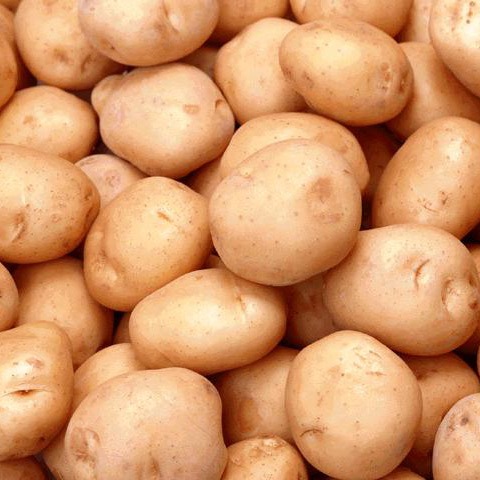
Potatoes, a common starch
Starch is an energy storage polysaccharide found in plants, specifically in their granules. (Want to know more about cell parts?  Click here.)  These molecules are spiral shaped, allowing for more efficient and compact storage.  The presence of starch enables a plant to stockpile its excess glucose and use it later for energy.  Starch can be broken apart by both humans and animals for energy.  Starch is, in fact, composed of two distinct substances.  The first is known as amylose.  Amylose, making up 20% of the molecule's composition, is soluble in water and has a linear shape.  Amylopectin makes up the other 80%.  Amylopectin is branched and, for the most part, not able to be dissolved by water.  Examples of starch include corn, rice, and potatoes.  

2. Glycogen

Glycogen is starch's animal counterpart.  Mostly found in the liver and muscle cells, glycogen is essential to an animal's well-being.  Without glycogen, normal body conditions cannot be maintained for long periods of time.  In fact, human beings must eat some kind of food with carbohydrates, otherwise glycogen stores will be depleted and muscle capabilities will be decreased.

3.  Cellulose

A cross-section of wood.

Cellulose provides structure to plants.  It is a straight, unbranched molecule.  Its components are held together by hydrogen bonds and mibrofibrils.  Cellulose is most commonly found in the cell walls of plants, and is the most commonly found organic compound on the planet.  Interestingly, cellulose is a polymer of glucose, with different glycosidic linkages than that of starch.  Hence, it has a flat shape while starch has a helix shape.  Cellulose is the main component in wood.  Some species of animals, such as termites, have special enzymes that enable them to digest this substance, however humans cannot digest it.


4. Chitin

Chitin is the structural carbohydrate found in many animals.  It is present in the exoskeletons of insects, and the cell walls of funguses.  Chiten has beta linkages with nitrogen attachments, creating its hard, tough surface.  


Sources:
Campbell Biology 9th AP Edition
http://www.medicalnewstoday.com/articles/161547.php
http://www2.chemistry.msu.edu/faculty/reusch/VirtTxtJml/carbhyd.htm
http://www.mansfield.ohio-state.edu/~sabedon/068dhsyn.gif
http://homebrewsake.com/wp-content/uploads/2010/04/glucose.gif
http://stemlynsblog.org/wp-content/uploads/2012/07/starch.jpg
http://upload.wikimedia.org/wikipedia/commons/thumb/0/0b/Taxus_wood.jpg/300px-Taxus_wood.jpg

Wednesday, January 18, 2012

Study Reveals Ability of Yeast to Quickly Evolve

An article on today's New York Times chronicled a fascinating study at the University of Minnesota, a study that may change the way we study evolution. In the study, students discovered that yeast cells used to brew beer can form basic bodies in approximately two weeks.


Researchers created an experiment in which brewer's yeast was fed sugar and encouraged to reproduce, in hopes that the typically unicellular organism would perhaps create some kind of multicellular creature. To encourage this evolution the scientists raised so called "lines of yeast" from a single cell in 10 individual flasks full of "broth" - a soupy substance of nutrients. The flasks were shaken constantly for twenty four hours, and then allowed to settle. One drop of settled cells were put into a new flask and the yeast grew again. This meant that if the yeast fell quickly it would have a larger chance of survival. In a few weeks Dr. Ratcliff, the leader of the study, found that the yeast cells fell rapidly and created a small cloud of yeast at the base of the container. When examined under a microscope, it appeared that the yeast was, in fact, growing in small colonies. Each of these contained hundreds of individual cells. These colonies appeared to be in the shape of snowflakes, and appeared after a mere 60 generations of cells.

One cell of yeast would grow to full size in a matter of hours. Then it's "branches" that grew outwards would cut into each other until they broke. The broken branches would then each sprout another yeast section, which would again snap. This phenomenon is not unique to yeast. A group of unicellular organisms, choanoflagellates, often grow in the same way.

The researches plan to continue their work by looking into the genomes of the new yeast organisms, attempting to find the mutation that allowed for this growth. The yeast themselves are still evolving, changing so that they may reproduce faster and grow more.

source:
http://www.nytimes.com/2012/01/17/science/yeast-reveals-how-fast-a-cell-can-form-a-body.html
http://www.scientificamerican.com/article.cfm?id=test-tube-yeast-evolve

Image courtesy of:
http://dft.ba/-yeast

Saturday, December 31, 2011

What Smells? How We Perceive Scents.

Take a deep breathe in through your nose. What do you smell? Lunch? Pencil lead? Somebody mowing the lawn? Whatever it is, you just utilized one of the most basic senses we humans possess. It can alert us to the danger of a fire or rotting food, and allow us to appreciate the scent of flowers and perfumes. But how exactly does the sense of smell work? 

When you inhale, chemoreceptors (a form of sensory cells) detect tiny molecules of the substance that are floating in the air. Everything and anything that you smell gives off these molecules. These chemoreceptors are specialized neurons, similar in size to a stamp. This section is referred to as the olfactory epithelium. They are exposed to the air and project cilia outwards to increase surface area. The molecule of smell will attach to the cilia and cause a reaction in the neuron. The chemoreceptor then  sends electrical signals to the brain, which then interprets the signals and converts them to a smell. 
Fascinatingly enough, every chemoreceptor is encoded by a separate gene. If this gene is missing or not intact, one will not be able to smell a specific scent. If these neurons are lost or damaged, they can result in a syndrome called anosmia. Anosmia is the total loss of smell, and can have many causes. These include, but are not limited to:
  • head trauma
  • old age
  • toxins
  • intranasal drug use
  • smoking

  • nasal polyps
  • upper respiratory tract infection. 
More interesting than the basic process of smell, however, is its connection with memory. A specific smell can evoke various memories and moods in different people. This is due to the fact that the part of the brain that deals with smell (the olfactory bulb) is positioned inside the limbic system - the section of the brain that deals with memory and feelings. This allows connections to be made between these two systems easily. However, the key aspect of this phenomenon is the idea of "conditioned responses." When one encounters a new scent, one connects it with the place and activities that are ongoing. For instance, the musty smell of old books in a library, or the scent of baking cookies at your grandmother's house. This may be part of the reason why people show different preferences towards various smells. 

Sources:
http://science.howstuffworks.com/environmental/life/human-biology/smell.htm
http://health.howstuffworks.com/human-body/systems/nose-throat/question139.htm
http://en.wikipedia.org/wiki/Anosmia
http://en.wikipedia.org/wiki/Olfaction

Images courtesy of:
http://www.boston.com/lifestyle/health/articles/2011/07/18/how_smell_works/
http://purplepaperplanes.files.wordpress.com/2010/03/smell_flower.jpg


Friday, December 30, 2011

Cellular Respiration

A video I made last year for my bio class explaining cellular respiration:

Allergic to your Cell Phone?

When you think about cell phones, what comes to mind? Texting, perhaps, the iphone, or even radiation. But an allergic reaction? In the past few years, scientists have been finding rashes on the faces of teenagers and adults, along the jawline. The cause of these rashes was a mystery, until recently. The New York Times released an article this Tuesday, which linked the rash toNickel found in cell phone casing.

According to Web MD, "A nickel allergy is a skin reaction that develops after exposure to nickel or items containing the metal." This essentially means that a nickel allergy is caused by touching or wearing nickel for a long period of time. In America, 3% of men have this allergy and 20% of women. This is because many items of jewelry contain nickel. Therefore, the jewelry wearers are more exposed to the nickel. This is the same process that occurs with cell phone users. However, with a cell phone user it is called, "Contact dermatitis with a Nickel allergy". If a person is constantly talking on their cell phone, the face can become hypersensitive to nickel. This hypersensitivity becomes an allergy.

A nickel allergy has several, rather similar, symptoms. The most common are:

  • A rash where the nickel has touched the skin
  • Itching
  • Red areas of skin
  • Dry areas of skin (these can look like burns)
  • Blisters
This allergy can come from other objects as well. Some examples are watchbands, zippers, belt buckles, hairpin, dental fillings, prosthetics, and even the frames of glasses. People with severe nickel allergies must limit their contact with some of these objects, and avoid eating oatmeal, chocolate, nuts, beans and dried fruit; which contain small amount of nickel. 

However, it is possible to treat this allergy. Doctors recommend using steroid creams, such as cortisone, and preventing any further contact by using a headset.


Link to a brief Masher video summarizing the cell phone issue:
http://www.masher.com/player.jsp?key=0dbe76c7-a2bc-cb73-63d8-0000effb001b&adscheme=0


Sources:
http://www.nytimes.com/2010/11/23/health/23really.html?_r=1&ref=health
http://www.webmd.com/allergies/nickel-jewelry-allergy
http://www.businessweek.com/lifestyle/content/healthday/645796.html
http://www.mayoclinic.com/health/nickel-allergy/DS00826/DSECTION=symptoms
http://www.cmaj.ca/cgi/content/full/178/1/23
http://allergies.about.com/b/2008/10/16/mobile-phone-allergy.htm
http://preparednesspro.files.wordpress.com/2009/06/person-on-cell-phone.jpg