 |
| Diagram of a glucose molecule. |
You've probably heard quite a bit about carbohydrates. When dieting you avoid them like the plague; they're in pastas, pizzas, and many other delicious Italian dishes. But what, in fact, is a carbohydrate? Carbohydrates are defined as molecules that are some form of sugar (either a polymer or monomer). These sugars are composed of three elements: Carbon, Hydrogen, and Oxygen in a 1:2:1 ratio. The carbohydrate most commonly found in nature is Glucose, with the molecular formula C6H12O6 (See right). Carbohydrates perform several key functions for cells. They store energy and they provide structure for living organisms. The simplest sugars, such as Glucose, are referred to as monosaccharides. Two monosaccharides can be combined to form a molecule called a disaccharide. The process by which this occurs is called dehydration synthesis. In dehydration synthesis, one monosaccharide donates a hydroxide ion (OH-) and another donates a hydrogen ion (H+). These two ions form one molecule of H2O.

The result is that the two monosaccharides are held together in a glycosidic linkage. Many monosaccharides can be combined in this way to form a polysaccharide. Polysaccharides are the molecules that we usually think of as "carbohydrates". They are composed of chains that have hundreds or even thousands of monosaccharides joined together via dehydration. Interestingly enough, these chains can be broken apart using a process named hydrolysis. Hydrolysis is, in essence, the opposite of dehydration. In hydrolysis, the bond between two monosaccharides is broken by introducing a water molecule. Energy is released, and the glycosidic linkage dissipates. This is how carbohydrates store energy, by creating large polysaccharides when energy is abundant and breaking up the polysaccharides when energy is scarce.
There are four common types of carbohydrates found in nature, described below:
1. Starch
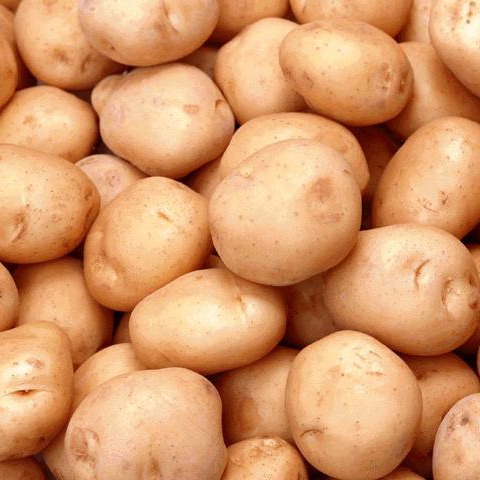 |
| Potatoes, a common starch |
Starch is an energy storage polysaccharide found in plants, specifically in their granules. (Want to know more about cell parts? Click here.) These molecules are spiral shaped, allowing for more efficient and compact storage. The presence of starch enables a plant to stockpile its excess glucose and use it later for energy. Starch can be broken apart by both humans and animals for energy. Starch is, in fact, composed of two distinct substances. The first is known as amylose. Amylose, making up 20% of the molecule's composition, is soluble in water and has a linear shape. Amylopectin makes up the other 80%. Amylopectin is branched and, for the most part, not able to be dissolved by water. Examples of starch include corn, rice, and potatoes.
2. Glycogen
Glycogen is starch's animal counterpart. Mostly found in the liver and muscle cells, glycogen is essential to an animal's well-being. Without glycogen, normal body conditions cannot be maintained for long periods of time. In fact, human beings must eat some kind of food with carbohydrates, otherwise glycogen stores will be depleted and muscle capabilities will be decreased.
Cellulose provides structure to plants. It is a straight, unbranched molecule. Its components are held together by hydrogen bonds and mibrofibrils. Cellulose is most commonly found in the cell walls of plants, and is the most commonly found organic compound on the planet. Interestingly, cellulose is a polymer of glucose, with different glycosidic linkages than that of starch. Hence, it has a flat shape while starch has a helix shape. Cellulose is the main component in wood. Some species of animals, such as termites, have special enzymes that enable them to digest this substance, however humans cannot digest it.
3. Cellulose
 |
| A cross-section of wood. |
Cellulose provides structure to plants. It is a straight, unbranched molecule. Its components are held together by hydrogen bonds and mibrofibrils. Cellulose is most commonly found in the cell walls of plants, and is the most commonly found organic compound on the planet. Interestingly, cellulose is a polymer of glucose, with different glycosidic linkages than that of starch. Hence, it has a flat shape while starch has a helix shape. Cellulose is the main component in wood. Some species of animals, such as termites, have special enzymes that enable them to digest this substance, however humans cannot digest it.
4. Chitin
Chitin is the structural carbohydrate found in many animals. It is present in the exoskeletons of insects, and the cell walls of funguses. Chiten has beta linkages with nitrogen attachments, creating its hard, tough surface.
Sources:
Campbell Biology 9th AP Edition
http://www.medicalnewstoday.com/articles/161547.php
http://www2.chemistry.msu.edu/faculty/reusch/VirtTxtJml/carbhyd.htm
http://www.mansfield.ohio-state.edu/~sabedon/068dhsyn.gif
http://homebrewsake.com/wp-content/uploads/2010/04/glucose.gif
http://stemlynsblog.org/wp-content/uploads/2012/07/starch.jpg
http://upload.wikimedia.org/wikipedia/commons/thumb/0/0b/Taxus_wood.jpg/300px-Taxus_wood.jpg
http://www.mansfield.ohio-state.edu/~sabedon/068dhsyn.gif
http://homebrewsake.com/wp-content/uploads/2010/04/glucose.gif
http://stemlynsblog.org/wp-content/uploads/2012/07/starch.jpg
http://upload.wikimedia.org/wikipedia/commons/thumb/0/0b/Taxus_wood.jpg/300px-Taxus_wood.jpg

