Search This Blog

Showing posts with label genes. Show all posts

Saturday, April 7, 2012

Taste - A Tongue in Cheek Sense

Picture courtesy of: dft.ba/-2luc
To function as human beings, we all need to eat. Food powers our bodies, allowing for the production of ATP (as previously mentioned on this site) which enables us to perform any and all of our activities, from breathing to dancing and thinking. Taste is essential to consumption. If food were tasteless, there would be little motivation to fuel our bodies. Therefore, we developed a way to enjoy various foods that would fuel our bodies.

On the top of one's tongue there is a collection of organs known as gustatory calyculi or, more commonly, taste buds. The tongue is home to approximately 100,000 individual taste buds. Each of these buds contains about 50-100 cells known as "taste cells" each of which, contrary to popular belief, can perceive a variety of flavors. These cells have a life span of 1-2 weeks before they die and are replaced. There are additional buds on the top, sides, and rear of the mouth, along with the throat. The gustatory calyculi are able to perceive five different types of flavor; bitter, sweet, salty, sour, and savory (often referred to as "umami," a Japanese word that means savory). 

Bitter
Some examples of bitter foods
The perception of bitter taste occurs on a certain receptor in the taste cell known as a G-protein-coupled receptor, specifically the taste receptors, type 2 (TAS2Rs). On these receptors, the substance combines with a substance known as gustducin. Then calcium ions (charged particles) depart from a section of the cell known as the endoplasmic reticulum. These calcium ions create a neurological response in the brain that triggers the "sensory neurons" in charge of perceiving the bitter taste. Interestingly enough, the tongue is more sensitive to bitter flavors than any others. Evolutionarily, this is most likely due to the fact that many toxic foods are quite bitter. Therefore, people more sensitive to this flavor would have been more likely to survive natural selection. Two man made substances, PTC (phenylthiocarbamide) and PROP (6-n-propylthiouracil) taste very bitter to people with specific genetic make ups, but are tastless to people with other genotypes. This is a common test to determine if one is a "supertaster" (more on this later).This ability to taste these chemicals is cause by just two alleles (at TAS2R38 location). 

Some examples of sweet foods, specifically candies
Sweet
Sweet food perception also occurs on G-protein-coupled receptors, specifically T1R2+3 and T1R3. It also involves combining the foodstuff with gustductin. How sweet the substance is perceived as depends on how tightly it binds with the two receptors. 


Salty
Table salt, or NaCl, commonly found in salty foods
The taste receptors for salt, specifically sodium chloride (NaCl) are channels through which sodium ions can flow into the cell. Calcium ions also enter the cell and again trigger a neurological response the causes the perception of the salty flavor. There is one hormone known as aldosterone that regulates the number of salt receptors in the mouth and also the levels of sodium in the body. Other substances that can trigger a similar response include KCl )potassium chloride), NH4+ (ammonium), and cations from the group of alkali earth metals.

Some sour fruits commonly found in nature
Sour
The flavor of sour foods is caused by their acidity. Acidity of a substance is relative to its number of H+ ions, so it is natural that these ions would be the cause of the sour perception. The taste cells perceive sour by expressing the protein PKD2L1. However, the H+ ions themselves can also illicit the taste response, so this gene is not required for this taste perception. 
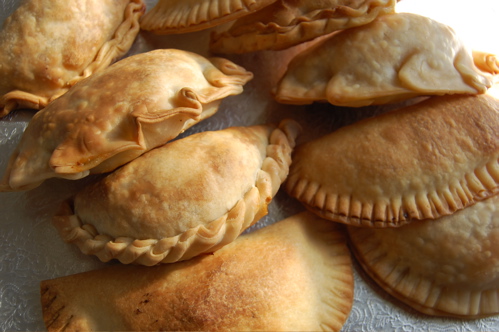


Some Savory Empanadas
Savory (Umami)
The perception of the umami taste comes from glutamic acid salts (for example, MSG, which is often found in chinese food). This once again occurs on the G-protein-coupled receptors, specifically the glutamate receptors, subsets T1R1 and T1R3. 

Supertasters
One of the most fascinating evolutionary phenomena associated with taste is that of the supertasters. It is believed that this anomaly is caused by an increased amount of taste buds present on the tongue. The first mention of the term "supertaster" was in a study conducted by Linda Bartoshuk. She was conducting a study on taste perception in the 1990s, when her research team noticed that some of the participants had increased response to tastes. As previously mentioned, the ability to taste the chemicals PTC and PROP have been linked with the ability to super taste. It appears that this specific taste receptor comes from one gene (TAS2R38). People who express this genotype prefer sweets as children, do not enjoy alcohol as much as their counterparts, less vegetable consumption, and a lessened tendency to smoke. It is estimated that 25% of people are are supertasters, 50% are regular tasters, and another 25% have a decreased number of taste buds. 

If you don't have access to PROP or PTC, here's a quick and easy test to see if you are a supertaster:

Step 1:
Using blue food color or a blue lollipop, stain your tongue blue. 

Step 2:
Place a piece of hole punched paper on your tongue, making sure that the hole is on top of the blue stained area.
The tongue of a supertaster

Step 3:
Look in the mirror. Using a magnifying glass, count the number of papillae you see. (Unlike the rest of your tongue, the papillae will be unstained). 

If there are more than 35, you are likely a supertaster. If there are 15-35, you are a medium taster, If there are less than 15, you are a non-taster.


Fun Facts:
-Women are more likely to be supertasters than men
-Asians, Africans, and South Americans are also more likely to be supertasters
-The bass player for the band Muckaferguson is a supertaster. They Might Be Giants wrote a song about him (John Lee Supertaster)
-Supertasters like salty foods
-Supertasters are less likely to enjoy fatty and sugary foods
-Supertasters are generally more skinny than regular tasters because they do not enjoy many unhealthy foods, however, they have elevated risk of colon cancer because they do not enjoy bitter vegetables

Still unsure if you're a supertaster or regular taster? Try this test, provided by the BBC. 

Sources:
http://users.rcn.com/jkimball.ma.ultranet/BiologyPages/T/Taste.html
http://faculty.washington.edu/chudler/tasty.html
http://en.wikipedia.org/wiki/Taste
http://en.wikipedia.org/wiki/Supertaster#Identifying_a_supertaster
http://www.todayifoundout.com/index.php/2010/06/how-to-tell-if-you-are-a-supertaster/
http://www.npr.org/templates/story/story.php?storyId=127914467
http://www.bbc.co.uk/science/humanbody/body/articles/senses/supertaster.shtml

Images:
http://hecooksshecooks.net/wp-content/uploads/2009/05/bitter-foods.jpg
http://www.virginmedia.com/images/ysp%20food%206%20sweets%20on%20la%20rambla,%20barcelona%20by%20helen%20sandell.jpg
http://whatscookingamerica.net/Information/Salt1.jpg
http://www.petitekitchenesse.com/wp-content/uploads/2010/10/fruit.jpg
http://joepastry.site.aplus.net/pics/empanadas1.jpg
http://blogsoop.com/blog/wp-content/uploads/2007/07/supertasters_supertaster.jpg

Friday, December 30, 2011

Mendilian Genetics; or, Why Can't I Curl my Tongue?

For the past few days I have been investigating genetic traits. These traits are determined by alleles. You receive one allele from each of your parents. These alleles can carry the genetic code for a dominant or recessive gene. If you receive two dominant alleles or one dominant and one recessive allele, you will express the dominant trait. If you receive two recessive alleles you will express the recessive trait. I tested myself and a variety of my family members for four different traits. These traits were: attached ear lobeswidow's peakhitchhiker's (bent) thumb, and ability to curl your tongue. My findings are below.

From this chart I was able to create the following three pedigrees:

Pedigree for Attached Earlobes. 

Pedigree for Widow's Peak

Pedigree for Tongue rolling
I was quite surprised that only one member of my family had unattached earlobes, none of my family had widow's peaks, and that neither my cousin, my brother, nor myself was able to roll our tongues while our parents could. I found this odd because unattached earlobes are dominant, widows peaks are dominant, and tongue rollers are dominant. I was unable to create several pedigrees because my grandparents could have been AA and Aa or Aa and Aa. There were several such situations, in which it was impossible to find a result.

Gene Therapy

A diagram explaining Gene Therapy
Imagine the treatment of a cancer patient. It is typically a long string of doctors appointments, surgeries, and medications such as chemotherapy. But what if there was a way to treat cancer with a simple injection? It seems incredible, and yet this is the aim of a new type of medical treatment called gene therapy. Not only would gene therapy treat cancer, but it could also treat cystic fibrosis, familial hypercholesterolemia, HIV/AIDS, gaucher disease, hearing loss, and could allow patients with circulatory problems in the legs to avoid amputation.

So, how would this incredible process work? It would begin on a molecular level. All of the aforementioned diseases and complications are caused by imperfections and mutations of the DNA. These are obviously very hard to treat with medications, and are typically hereditary. They can affect almost any part of the DNA. It is clearly quite hard to change a gene that is written into each and every cell in the human body, and coming up for a cure for these diseases has always been quite daunting. This is where gene therapy comes in. Gene therapy is the use of genes as treatment or prevention for diseases.

Using genes as a treatment? As fantastical as it sounds, this is the reality of gene therapy.  A "normal" gene is put into the genome in place of an "abnormal" gene which causes a disease or disfunction. This is done with several different treatments which fall under two headings: Germ-line gene therapy and somatic gene therapy. Germ-line gene therapy is when genes are introduced into reproductive cells or into embryos, so that the child will not have genetic abnormalities. On the other hand, somatic gene therapy is when therapeutic genes are inserted into cells to replace the current DNA or to make a protein/substance that is not present or not working in the patient. Most current research is developing somatic gene therapy.

Somatic gene therapy usually works via a "vector". The vector delivers the new gene to the patients cells. These vectors are almost always a virus which has had the infectious DNA replaced with the proper gene. These are either a retrovirus (such as HIV, which works well in dividing cells), an Adenovirus (such as the common cold, which works well in non-dividing cells), an Adeno-associated virus (which inserts DNA at a specific singular site on chormosome 19) or Herpes simplex virus (typically causes cold sores). There are new ways of developing gene therapy, including introducing the DNA directly to the cells, creating an artificial lipid with a water-based core which can travel directly through a cell membrane to deliver the gene, chemically linking the DNA to a molecule that attaches to the cell receptors, or even adding a 47th chromosome, which would not affect the cell in any way other than changing the defective gene.

Like any advancement in science, there are some questions and possible complications that come up when discussing gene therapy. If we put aside the omnipresent issue of "playing god", there are still a few problems. The primary problem is the use of viruses. Many scientists and researchers fear that one of the viruses injected into the DNA will go awry. Instead of being completely removed, the original virus would still retain its own DNA and begin infecting people. Although this is a justified concern, I believe that the benefits far outweigh the risks. If the makers of the injections are thorough in their testing, the company can have a product that is both safe and infinitely helpful to the modern world.

Check out this game about gene therapy!


A Gene that can Cure Cancer and Diabetes?

When you think of a cure for cancer and diabetes, what comes to mind? Probably scientists, hard at work in a lab. But surely not a group of Ecuadorians who are all under three and a half feet tall. According to this article, scientists have discovered a that these people are immune not only to cancer, but also to diabetes. This is because they have a disease known as Laron syndrome, and it may be the key to finding a cure for two very deadly diseases.


The cause of this syndrome is directly tied to the cell cycle. It turns out that Laron syndrome is caused by a specific mutation of a gene which is a receptor for Human Growth Hormone. This gene is known as IGF-1, and if a person has Laron syndrome they have very little IGF-1. Therefore, the Human Growth Hormone is not accepted by the cells, and the person does not grow. This ties into the ideas of proto-oncogenes and tumor suppressors. Certain parts of the cell, called proto-oncogenes, tell the cell when to go through the cell cycle and split apart. If there are no proto-oncogenes, as with Laron syndrome, the cell will not split.


This is a remarkable progression in the war against cancer and other deadly diseases. If scientists can find a way to change the ways our genes deal with the Human Growth Hormone to cure cancer without harming us in any other way, it would be truly remarkable. However, I highly doubt this could happen. It is always dangerous to mutate a person's genes, and without proper checks this could create even larger problems than cancer itself. Nevertheless, it seems that the secret to curing cancer could really have been hiding in a small village of Ecuador.


Sources:
http://www.nytimes.com/2011/02/17/science/17longevity.html?_r=1